Saturday, October 21, 2017

What are they REALLY saying?

We, as people, say things all of the time. But do we always say what we mean? Often, we have to look beyond the words and interpret what is really going on, even if it is not exactly what is being said.

I often have to do this with myself as well. When I am feeling grumpy, stressed, frustrated, or upset, it's easy for me to focus on the immediate thing going on, rather than the underlying issue. Whether conscious or subconscious, I'm not always honest with myself at first...and I am always grateful for friends who ask me the right questions to tease out my deeper thoughts and motivations.

"I don't want to do this!"

Is there something you don't understand about it? Is there something else going on that is stressing you out? Has something happened in the past that makes you feel like this won't be a good experience? What is the part that you are dreading the most? Why?

"I'm so stressed out."

What is stressing you out? What parts of it are under your control? What parts are not under your control? Do you need to take a quick break to refresh your mind? Are you getting enough sleep? Eating well? Is there something else going on in the background that is increasing your stress level? What would help you feel better? Can you do anything small right now to feel like you are moving forward?

My natural instinct is to want to focus on the specific issue, to give advice, or share a related story from my own life, but I am trying to become more of a question-asker (both in my own thought life and with others). Along with helping figure out what's really going on, it communicates to people that they are heard and valued. It suspends judgment and seeks more information, honoring the fact the people usually have a reason for their actions/feelings.

As a person who is in a coaching role now, it is so important for me to help others discover their own answers instead of "being an expert". I want to help us focus on the bigger issues, not just the symptoms that bubble up from day to day.

"What if students use technology for bad things?"
"It's just all too much, too overwhelming."
"We need to be more aligned in our vision."


What are people really saying?

Saturday, October 14, 2017

Tips & Tricks: #geniushour Evaluation Template

It's fall!

Students are settling into the school year, parent-teacher conference time is upon us, and everyone is well into the school routine now. In addition to all of this, is anyone kicking off #geniushour projects?

I have been so excited to talk to several teachers in my district who are either working on #geniushour right now, or planning to do so in the future. Although I'm not in the classroom this year, I have found myself pulling up my students' evaluations of our #geniushour last year to share with others. If you are curious, I go into more detail on the results in this blog. Looking at data and real student comments has been incredibly helpful in planning on how to make this time even better in the future - both for myself and for others!

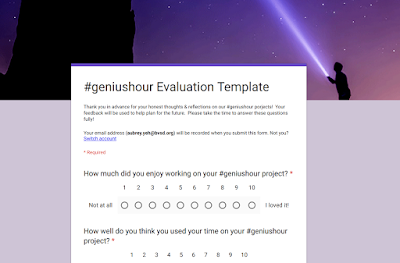
Even though many of us are at the beginning of our #geniushour journeys, I am always looking ahead to how we will evaluate & document our learning at the end. To that end, I've created a template of the Google Forms survey I gave my students at the end of the year. I know there are many great resources out there, but I was very happy with the data I received from it, and if it saves someone a bit of time so that they don't have to reinvent the wheel, that's a win for all of us in education! Make your own copy here & adjust as needed.

#geniushour Evaluation Template


I believe in the power of students engaging in authentic, passion-driven projects. I can't wait to see what they come up with! Please share so we can all benefit!

Saturday, October 7, 2017

Tech Doesn't Inspire...Teachers Do!

Can I be honest? I've found myself complaining way too much this week. The weather has been dreary and gray, I've had some long days at work, and I'm just tired. I've been making a conscious effort the past few days to STOP complaining and instead focus on gratitude & the good I see around me. It's an hourly battle & a daily choice, but as I spend less time complaining, I have found it easier to really recognize how many great things are happening right in front of my eyes!

In my role as an ed tech specialist, I spend a lot of time planning PD and training others. Sometimes, this means the very basics, like how to use Google Drive or sharing ideas for improving workflow. Sometimes, it bridges to more instructional uses, like finding the right tool for the desired use or "leveling up" a unit plan based on the SAMR model. What I don't always get to see is the follow-up to these interactions - how things are applied in real life with students.

That's why I have been so excited this week to hear about some awesome things happening in our schools! Teachers really are amazing...they can take an idea and run with it, and turn it into so much more!

This week, I've heard about:

  • Teachers connecting their classes to real-world events (like the recent hurricanes), running a fundraiser via social media, and being able to see the tangible results that their money is bringing via a video chat
  • Teachers embarking on a journey to meet the needs of all students by developing parallel lesson plans/units with similar content, one for students who are English speakers and a scaffolded version for newcomer students who are learning the English language
  • Teachers who are collaborating across three grade levels in elementary to have students engage in research, write a script, film a video with the green screen, and put the final project together to show their learning
These are just a few examples (I know I've forgotten some that I wanted to share, because there's just too much awesomeness going on in our schools right now)! While all of these endeavors use technology, none of them are really about the technology. It's the creativity, expertise, and caring of the teachers that has really brought these lessons to life. The tech tools are simply avenues to build amazing experiences for kids. And THAT is what it should be about. THAT is what gets me excited. THAT is why I am in this job!

Thank you, teachers, for inspiring me this week!

Saturday, September 30, 2017

#bettertogether - What does it mean?

#bettertogether

This hashtag is thrown around all of the time by educators on Twitter (myself included), but what does it really mean?

Does it mean that I agree with you?
Does it mean that you gave me an idea or inspired me?
Does it mean that I am cheering you on?

You see, the danger with #bettertogether is that it can become an echo chamber. We all need our tribe, our people who understand us, our people who will encourage us is whatever we are doing. It's nice to feel accepted and understood, especially when we sometimes feel like we are in a constant battle against time, rules & regulations, and models of education that we don't agree with. Yet if we only interact with those who agree with us, we risk getting stuck in a rut.

"As iron sharpens iron, so one man sharpens another." ~Proverbs 27:17

I'll admit it, sometimes I can be a little obnoxious because I don't mind playing the devil's advocate. I want to ask those questions to push and prod and poke, with the goal of making us think more deeply. I also don't want to be afraid to ask the hard questions - to ask about the true purpose of what's going on, to challenge others if their ideas are more show than substance, or to hold people accountable when necessary. It's not always easy to do this - it feels risky. And the only way for it to work is with a foundation of respect and understanding that we trust each other and we trust that we are working for the common good. Without that trust, it quickly can degenerate into taking things personally or creating an "us vs. them" mentality.

What if #bettertogether meant that I will push back on you if I see something that doesn't quite fit?
What if it meant that I will ask you to justify your idea, so both you and I can understand it more deeply?
What if it meant that you have permission to do the same to me?

Does this feel a little uncomfortable to you? It certainly does for me! But, this is the true power of #bettertogether. when we not only celebrate our successes, but also challenge each other to grow. It is easier and more comfortable to gravitate toward those who will always cheer us on and give us positive feedback. It requires vulnerability and courage to go to someone who is not afraid to push a little or who feels differently than you do about a certain subject. The world is not made up of carbon-copy people - we will run into opposition at some point - isn't it better when it first comes from a friend? We don't do each other any favors by solely cheering each other on without digging deeper.

It's not always easy, but this is the way for us to truly be #bettertogether.

Saturday, September 23, 2017

Flexibility

Recently, I have been thinking quite a bit about the characteristic of flexibility. My favorite definition comes from training I had before traveling overseas in college:

"A flexible person is capable and active in adapting to new situations."

As I think about teaching students and preparing them for a world that is ever-changing, growing the value of flexibility in them seems to be a pretty good idea!

My story: This week has been a great example of flexibility in my job. Due to some maintenance issues, I have not been able to be in my office all week. This means that I've been working from home or from conference rooms at various schools, doing meetings via Google Hangout, and communicating via email/text rather than in person. I'll be honest, while it's a nice change of pace in some ways, it's also been a little unsettling - I am so used to my routine! Along with all of this, some different topics have bubbled up in conversations, so our carefully planned agendas for meetings have been thrown out the window. None of this is bad - it's just life! But it has given me ample opportunity to exercise my own flexibility.

Now, with students: When I was teaching, as we prepared for concerts, I wanted to throw students into situations where they were a little uncomfortable. After all, we couldn't replicate the environment of being under the lights with hundreds of people staring at you, but I knew it would not go well if we were only used to our classroom in ideal conditions. We practiced in different places where everything sounded different, changed our seating, and played "previews" for smaller audiences. All of this was aimed at growing flexibility so whatever came in the concert would not throw them off too much.

Beyond concert preparation, there were other ways to teach flexibility in the classroom. Any interruption, alternate schedule, room change, or lesson that didn't go well became an opportunity to model my response in less-than-ideal circumstances and set expectations for my students to do the same. And they picked up on it! By the time I had students as 8th graders, I was confident that our group could be put into almost any situation and respond well (and that was proven time and time again). Bonus: in the moments where MY frustration got the best of me, my students modeled flexibility and reminded me to take a deep breath and move on.

And then there were the moments where I intentionally built my classroom & lesson plans to force students to be flexible. This is such a real life skill, we can't afford to miss out on it! How are we teaching our students to adapt? To go beyond making a change, but to actively engage in the process and actually improve their work as the result of a new situation? If we don't give students opportunities and safe spaces to practice flexibility, they are missing out. Routines and structures are important, to be sure. But nothing ever stays perfectly routine for long - we have to be prepared for change.

How do you teach & model flexibility in the classroom? 

Saturday, September 16, 2017

#EdCampLongmont 2017

There's nothing like showing up on a Saturday morning with a large group of educators who just want to collaborate and learn and "talk shop" with each other! Welcome to #edcamp!

It's hard to synthesize all of the learning & thought-provoking conversations that occurred throughout the day, so I'll just share a snippet from each session here:

1. Sometimes, kids need more structure. It is easier for us, as adults, to discriminate what information is important, switch gears, and make the appropriate connections...but students don't always follow our same train of thought! Being clear about this can help our kiddos know what is expected of them and then they can focus on the learning. This is so important for me to keep in mind because I tend to be pretty flexible, and I need to remember to accommodate a variety of learning styles.
Challenge: How can we create structure & clear expectations while facilitating a classroom that is student-led & honoring students' desire to learn in their own individual ways?

2. What are the different purposes for social media (personal, professional, academic, etc) - do students think about using their accounts in all of these different ways?
Deep thoughts & possible conversation with students: Who are YOU as a person and how do you convey that online? Do you have more than one account on a given social media platform? Why or why not? What are the pros & cons of having one account or multiple accounts? How does that affect the way you communicate? What about who your audience is? Does that change the way you portray yourself online? What are the similarities and differences to how you portray yourself online and in real life?

3. I'm still trying to up my game on Schoology. I never used it in my classroom, and while I am getting better, I continue to do a lot of playing around to find what I need. It was great to hear about tips & tricks (& also frustrations) from other teachers!
Question for the masses: What is your best tip or trick on Schoology?

4. Honestly, I just took some time to reflect and catch up. There was nothing on the session board that was calling to me, and it was nice to synthesize all of the information from the morning. It's okay to slow down too!
Challenge: How do you build in time for reflection?

5. Although I am an ed tech specialist now, there is still a big part of me that is a music teacher. This last session felt like coming home. We reflected on how easy it is to feel alone when you teach certain subjects, the challenges of finding relevant PD, and dreamed about organizing a music edcamp for ourselves and our colleagues.
Music teachers: What kind of PD do you find most relevant?

In addition, it is always super fun to see old friends, make new friends, and be around people who are so excited about education!

So...when's the next #edcamp?

Saturday, September 9, 2017

Work, Work, Work...What About Life?

This post is cross-posted on Mari, Meagan, & Aubrey’s blogs.

Mari is a middle school Science & AVID teacher and Blended Learning Specialist in San Diego, CA.
Meagan is a middle school Math, AVID, & Technology teacher and the Team Technology Leader in Hesperia, CA.
Aubrey has been a music teacher & Summer Learning principal, and is currently an Educational Technology Specialist in Boulder, CO.
Teach kids all day, then bring grading and lesson planning home at night. Does this sound familiar? If you asked a room full of teachers, I’m sure nearly every head would be nodding - this is the story of our lives! According to an NPR article, “Attrition is high, and enrollment in teacher preparation programs has fallen some 35 percent over the past five years — a decrease of nearly 240,000 teachers in all." Budget cuts, paperwork, behavior challenges, and ever-increasing demands add extra stress to our already stressful jobs.


Work/life balance has always been struggle for all three of us. We have this tendency to work many hours past the required hours of our teaching days. It’s very common for us to get into work early, leave an hour after our days finish, and spend a large portion of our nights working on lesson planning, grading, blogging, or various side projects. If you’re thinking this sounds like some “Woe is me” story – it isn’t.


In the end, the underlying issue is that we love what we do. We love being teachers, working with students, developing lessons and, yes, even grading and reviewing their work. Education has never been just a “job” to us – it’s a major part of our identity. It’s our passion. And we spend a large portion of our days working on various projects because we enjoy it. However, we began to realize that it isn’t healthy for our work/life balance or the relationships with those around us to work the majority of the week.


Enter the idea of Work Rules. We each began to create boundaries for ourselves, unique to our specific situations, and write them down. We were amazed (and horrified) at how challenging it was for us to try to define some limits to our work! We also included reminders of what we could do instead of work [behavioral therapy concepts - you can’t just extinguish a behavior without developing a replacement behavior] and why we were doing this in the first place. Then we gave permission to hold each other accountable, which has been key to changing our habits.


Aubrey: I’ll be honest, there is no silver bullet to finding and maintaining balance. I still bring more work home than I would like and don’t always follow my “work rules”. That being said, I have noticed a definite difference in my mindset as we’ve gone through this journey. A night without work is becoming something to be celebrated, rather than a reason to feel guilty. I find myself asking, “Does this really need to be done at home, or could it wait until tomorrow?” more often. And I am slowly getting better at setting limits for myself, such as only bringing one project home (instead of everything that needs to be done) or setting a timer for how long I work (once it goes off, no more work for me)! The accountability and camaraderie has been huge - for picking me up when I am struggling, for spurring me on to do better, and sometimes just to have a place to share how hard this is! In this ongoing journey of living LIFE to the fullest, I am grateful for friends who are not afraid to ask the tough questions and provide gentle reminders when needed. It’s not always easy...but it is worth it!


Meagan: A couple of months ago, I really began to reflect on my work/life balance.  Around this time, Aubrey and Mari shared their idea for “work rules” and…it was amazing!  I quickly began to develop my own set of rules in hopes of developing some balance in my life.  As Aubrey mentions above, I still struggle with maintaining balance and following these rules but I can tell that there has been a definite shift in my mindset.  Although I have always been a good time manager, I’ve started to balance when I will do “work-work” (site/district) and when I will do my “side work” (blogging, presenting, etc).  I’ve been able to use much of my time at school to finish my lesson planning, grading, and projects which has opened opportunities to work on my “side work” projects at home.  Before, I was doing both and it was clear that this would not last forever.  I have also tried to set aside one day of the week where I do not do any “work-work” and at least one night where I do not do any work related to education.  I’ve definitely broken these rules several times but it has been helpful to have friends who check-in and encourage me to keep with these goals.  I still have a long ways to go on truly creating a work/life balance but…you have to start somewhere, right?

Mari: It’s been a constant battle for me to find the right work/life balance because teaching is both my passion and my job. However, I began realizing that in order to be the best teacher for my students, I also need to take care of myself. Prior to creating the Work Rules with Aubrey and Meagan, I felt guilty if I didn’t work all weekend and most weeknights. That pace was neither sustainable nor healthy for me. Now, I give myself all of Sunday off from anything education-related, and use this time to recharge, relax, and pursue fun things (like napping!). As both Aubrey and Meagan said, there are times the rules have been bent or broken; while I’m routinely committed to my Sundays off, I haven’t always given myself a few work-free weeknights due to school commitments or interruptions/distractions during my prep period. I’m so grateful for our group. Not only do they keep me accountable to my work/life balance commitments, but also they encourage and push me to be a better person!
We are on a journey together - far from perfect, yet always growing. Frequently just before or after work, we check in with each other to see what the day looks like and what our work/no-work plans are for the day. This keeps us centered throughout the day and into the evening.

What steps are you taking to balance work and life?