Showing posts with label sel. Show all posts

Saturday, February 6, 2021

Nightmares

As a teacher, it wasn't unusual for me to start dreaming about my classroom in August as we returned from summer break, or right before a concert. Every now and then, a nightmare would pop up where I had lost children or where everything broke or some other absurd variation on what could go wrong. It's a common experience among teachers!

Although my position has changed, these nightmares still have a way of sneaking up on you. I can tell I've been more stressed about things lately, because I had my first "FTE nightmare" this week! And in keeping with my attentive #oneword2021, I wanted to spend some time reflecting on where this stress is coming from. Here are some of the things keeping me up at night...

  • I'm worried about the future of all electives. Will we double down on math & literacy in an effort to "catch students up" and do so at the expense of the classes that round out their education?
  • In particular, I'm worried about the future of music education. Singing events have led to the spread of the virus (although there are many factors to these events), and I fear that, in the court of public opinion, the risk just won't be worth it. Will students not sign up, or will schools not offer these classes?
  • Then we come to the numbers game. In the electives world, your job is often determined by how many students sign up for your classes. Our enrollment is down across the board. Many students did not get the classes they signed up for this year due to schedule changes to make cohorts happen (they were just shoved into whatever elective class fit into their schedule). What impact will that have on next year?
  • Speaking of that, budgets. What will the federal and state funding for public education look like? My state is known for the B.S. Factor (yes, that's what it's called, the Budget Stabilization Factor, or B.S. factor for short) which creates a deficit in funding public education in order to balance the budget. Less money from the state = hard decisions about what that means in schools.
  • Which led to my nightmare. Of having to tell teachers that they are being let go or reassigned. And because our contract (similar to most) works on the basis of seniority, I dreamed about having to let go of some of our awesome teachers, who have created resources and shared and collaborated and worked like crazy to bring amazing content to our kids this year, because they happen to be lowest on the totem pole.
  • I worry about the teachers I have the privilege to serve and lead. People are exhausted. Hanging on by a thread. Burned out. The spark, the joy of teaching is often muffled these days because teaching at boxes with profile pictures just isn't the same. And the asks are mounting. Vaccine distribution seems to be bringing hope, but we are continuing to exist in this heightened state of fear and alertness, and our bodies can only take so much of that. And then you add in concerns about job security. Will we make it?
  • Ultimately, it comes back to our kids. I worry about their isolation, and also about the pressure they feel. These classes are connectors, they are places for kids who doesn't always do so well in academia to shine. They are often the highlight of a student's day. And with more information coming out about the impact of the pandemic on the mental health of children and teens, with every new story about a suicide or overdose, I think about how important it is that we don't just push our kids back into an environment of focusing solely on academics. There are other, perhaps greater, needs that we must attend to as well.
Usually, I try to be pretty positive on this blog, and I don't mean to say that it is all gloom and doom. I have seen amazing things happen this year, and I know that some good has come out of all of this! But I can't deny that these concerns are a constant rumble of low-level stress, and as planning for next year begins, they are starting to bubble up more.

As I reflect personally, I think that my goal is to hold all of this in balance. It is important for me to have these thoughts and acknowledge them, because they lead to advocating for what I believe is right and making wise decisions for the things under my control. But I can't let the fears overtake my life or drown out the joy of a profession where we truly get to impact lives. My hope for all of you is that, whatever your nightmares and dreams are, you will be able to balance it and still find the joy!

Saturday, November 16, 2019

A Tale of Two Conversations

I want to paint a picture of two conversations between a teacher and a student. Both started with a problem that needed solving.

In the first conversation, they talk about the issue.
The teacher helps the student brainstorm ideas about how to solve it, or at least what next steps might be. The questions that the teacher asks sound like this: "What is the root of the problem? What would make it better? How could you get there?"
They bounce ideas around and end up co-constructing a plan. In the end, they walk out of there with a clear idea of what to do next.

In the second conversation, they talk a bit about the issue, but more about the student who is seeking help.
The teacher asks questions to help the student reflect, such as, "What do you wish you could say? How do you think this is affecting you? What would you need to be able to move forward?"
They talk through these questions, and in the end, they walk out with some ideas of what to do, but a deeper understanding of themselves personally.

Both of these conversations are helpful, but they lead to slightly different outcomes.
Which conversation is more helpful in the short-term?
Which conversation is more helpful in the long-term?
Which conversation do you tend to have with your students?
How can we incorporate both angles into our interactions?

[Thoughts I'm pondering as I think about how to teach SEL skills, with both students and adults!]

Friday, October 25, 2019

The Importance of Our Strengths

For anyone who knows me or has been following my blog, it's probably not a secret that it has been a tough beginning of the year for me. A district reorganization, a new job, new teams, and a lot of change means that I've been spending a lot of energy the past few months adjusting to the changes. And it's been hard.

As I continue to struggle with settling into my new job, I've tried to figure out why - and I had a realization today. I'm spending far more time working out of my weaknesses than out of my strengths.

What does this look like, practically? I'm supporting subject areas I'm just learning, while the teachers I am supporting have been teaching this class for years. I'm spending most of my day in meetings, rather than being out with teachers and students. And, in the areas where I feel like I have strengths, the work has shifted to other people/job functions, so I am not supposed to be doing these things (so we can all settle into our new roles).

It's frustrating. I also know that we are still in the beginning stages of this change, and sometimes things just take time.

Meanwhile, this has sparked many thoughts for me about how we treat our students. Are there kids in your class who feel like they spend their whole day working out of their weaknesses, and desperately want you to recognize their strengths (whether they are in traditional academics or elsewhere)? Do they feel like they are cut off from using their sources of strength to aid in their learning? What does this do to their confidence and their view of themselves as learners?

I hope that we can all take a strengths-based approach to see the beautiful strengths all of our students bring. They may be learning English, and they have a rich cultural and linguistic heritage from somewhere else. Their family may be staying with another family right now due to financial constraints, and they might have learned how to get along with a wide variety of people. They may have a disability, and they might have learned to think creatively about how to accomplish things. Which side are we going to focus on?

I hope that we, as educators, can leverages students' strengths to build their confidence and capacity as learners, allowing them to move onto bigger and bigger challenges and ultimately to soar!

(And I hope that, one of these days, I will find ways to bring my strengths more and more into my daily work!)

Saturday, August 17, 2019

A Safe Place

Where is your safe place?

When you are having a hard day, where do you want to go "escape" to? Do you run to the bathroom? Is it your car? Do you just want to be home, or out somewhere at a special place?

Who do you pick up the phone to text or call? I know that I have certain people that I can text and say something short, like, "It's been a hard morning, please pray," and they will be there for me. I know that when I get those texts, it's not the time to ask a million questions, but a time to just be there (virtually) to provide support.

Do our kids have safe places?

The beginning of school is full of transitions and new things, and that can be overwhelming for some of our kiddos! With new teachers and classes and sometimes a new school, where is their safe place? Who can they go to? Do they have an outlet when they just need a moment to breathe?

Teachers, principals, and everyone else in schools - as we begin the year, please be willing to be a safe place for our kids. Respond with grace and compassion. Know that the beginning of the year and all of the change can trigger fear and anxiety in many students. Some will show it more than others, but they all need to know that they have a safe place at school if needed.

And for those of you who, like me, work in the central office - be a safe place for those you support. Working directly with kids every day can be emotionally draining, and sometimes we can help carry the burden that teachers feel every day, leaving our teachers with more energy to be on the front lines with our kids.

Do you have a safe place? Can you be a safe place?

I have the feeling that if we all did a little more of this, the world would be a better place ❤️.

Saturday, December 15, 2018

3 Ways to Build Community & Have Fun Together!

As the busy holiday season continues, I'm determined to not forget a few #selfcare tips (remember #MyRelaxing5?). Today's installment: 3 ways to have some team-building office fun!

1. Get outside & take a walk!

This one is super easy to implement. Find a buddy, and take a walk together! This gives you the chance to get some fresh air, to get some exercise, and to get to know each other in a little bit less formal setting. In Colorado, we are lucky enough to have sunny weather most days, but the temperature does vary quite a bit. Even when it's cold, put on your jackets/hats/gloves, and get out there!

I know it feels hard to give up even 10-15 minutes of plan time (or work time), but I have found that I am so much more productive after giving my mind & body a break, and I wouldn't trade the conversations and relationships for anything!

2. Stick Together

This activity was introduced to me by @zmidler, and has made an appearance in several school libraries! The basic idea is like paint-by-number, except with stickers - each little square (or pixel, so to speak) has a letter in it, and, using the key, you can put the thousands of different-colored little square stickers in the correct place. My favorite is pulling out the picture of the final product so you have to discover it as you go :-).
The fun of this activity is that it brings people together to work on something collaboratively! It is a great brain break that can last for 30 seconds or 10 minutes (just depending on how many stickers you add to the final product). And lots of people can be working on it at once!

I am not selling the product in any way, but if you want to find out more, visit www.letsticktogether.com. #adultslikestickerstoo


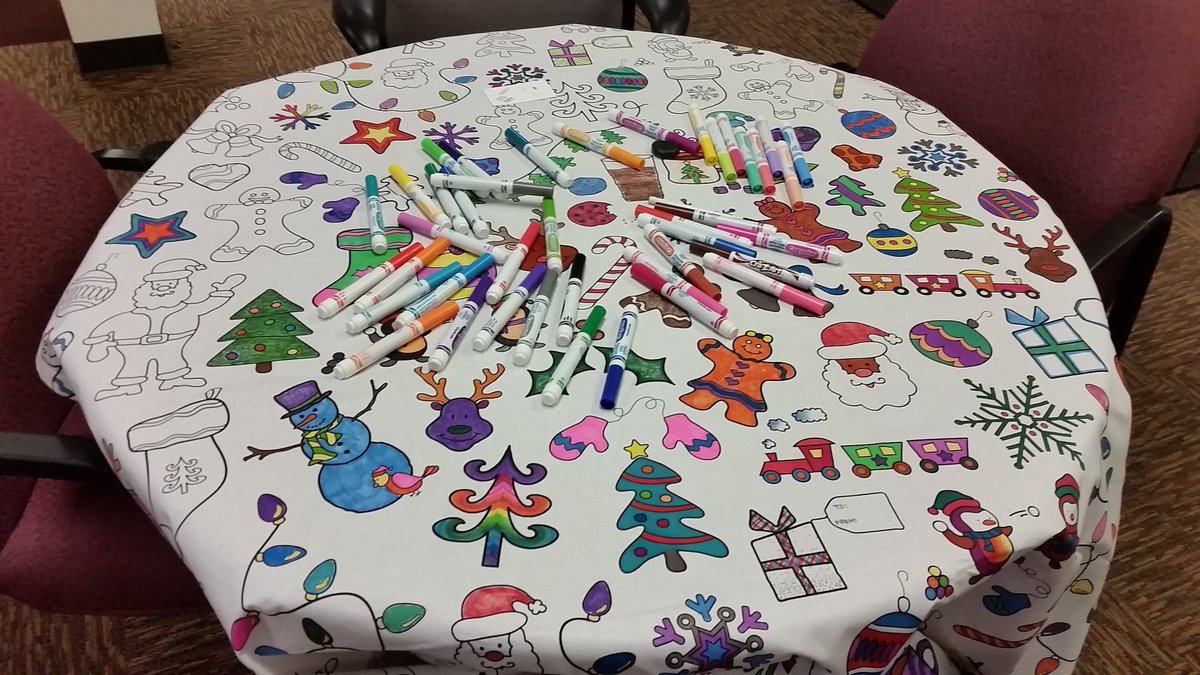
3. Coloring Tablecloths

This is another one I learned about from @zmidler - clearly, I like her ideas! Put out a coloring tablecloth + a bunch of markers, and see what happens! Coloring is a great brain break, and a chance to express your creativity! Just like StickTogether, several people can be working on it at once, and we've noticed that when one person sits down to color, it often draws more people in to take a quick 5-10 minute brain break, and builds community that way!

It's been interesting to see the progression of our coloring, as well. It started with being very concrete, and coloring in the lines, but as we get close to finishing it (and find ourselves coloring the same pictures at a different part of the tablecloth), people are branching out and being more creative in the way they use the markers to fill the space!

The bonus part of this is - if you use washable markers, you can wash it once you are done and start over again next year! Again, I am not selling anything, but if you want to find out more, here's the link: thecoloringtable.com. #adultscolortoo

As the resident director of Fine & Performing Arts, I love creative ways to bring people together - adults or students! What ideas do you have? Please share in the comments!

Saturday, August 11, 2018

Am I Welcome?

It's back-to-school time for many of us! In my district, students will start on Wednesday. As students, families, and even teachers come into the building after the summer break, there is a question that many are subconsciously asking.

Am I welcome here?


Can I be myself here? Will I be accepted, with all of my strengths, weaknesses, and quirks? Will people care about me? Will I make friends? Will I be left out? Is this a safe place for me?

Am I welcome here?


As I walk into a school, what cues do I use to help me answer that question?
  • What does the space physically look like? Does it look kid-friendly? Are there lots of signs, rules, & regulations?
  • How am I greeted? Am I even greeted? Is it with a smile? Do I feel like a guest, or like somebody who is interrupting others just to ask how to sign in?
  • Do I know where to go? Are there signs? Does anyone offer to help me find my way?
  • As I observe others in the building, are they happy to be there, or does it look like a struggle? Are there procedures in place? Do kids know the expectations of different areas?
  • What is on the walls of the hallway? Are they boring and institutional, or are they used to display and foster learning?
  • Does this place have its own culture, history, and identity? Is it a generic "school", or do they have pride in who they are?


Am I welcome here?


As a traveling ed tech specialist, I get to go to many buildings. They all have a different feel - part of the fun is seeing how each building has its unique identity! Some schools are older, some are newer, some are more strict, and some are more flexible. All of these are okay! And every school, no matter where they fall on those spectrums, can be welcoming. But the flip-side is also true - and I have seen both.

I had the privilege of visiting a school for the first time since I subbed there (once!) about eight years ago, and it immediately struck me as such a welcoming space. Even though students aren't there yet and most teachers were in training, I came in and was greeted by the office staff. I was a little early for my meeting, and I was welcome to sit down and wait (and get some work done!) in any of several places. I ran into a teacher, who gave me a tour of the building, told me about some of the work they are doing, and introduced me to other staff members. I saw smiles and waves, and was able to talk to several people around the building. I did not feel like an intruder - I felt like an outsider who was being welcomed in. And it felt good!

I know life can get busy. Spaces get neglected, we get absorbed in our work, and we don't always have time to give a tour. But education is a people business, and people are the most important thing. Even in the midst of a crazy day, we can always smile & greet people warmly, and let them know that,

"Yes, you are welcome here."

Saturday, July 14, 2018

Changes

Changes are all around us.
Some are big, some are small.
Some are easy, some are hard.
Some, we have control over, others, we don't.
How do we respond?

What we model is what kids learn.
What do they see in me?

Am I sad? That's okay.
Some changes come with loss.

Am I excited? That is great!
The future looks so bright!

Am I scared? That's okay.
Being stretched brings growth.

Opportunities are all around us.
Some are big, some are small.
Some are easy, some are hard.
Some, we have control over, others, we don't.
How will we respond?

As I ponder the changes that come with this new school year, I am filled with so many thoughts and feelings. It has made me think...our students, too, are experiencing many changes as they head into a new year. What are they thinking? What are they feeling? How can we model looking for the opportunities that come with changes while still acknowledging the sadness/fear/[insert emotion here]?

As important as our content is, it can never overshadow the life lessons - explicit and implicit - that we teach our kids. What are your students learning from you?

Saturday, April 14, 2018

The Other Side of the Table

This week, I was "that parent".

Okay, not truly a parent, but I was there with the family of one of the kiddos I help with (his family doesn't speak much English, so I often help in a parental role with the school stuff).

I was the one in the principal's office, called in because of his behavior. We needed to have a conference RIGHT AWAY, because he was on the verge of losing the chance to go on the end-of-year, overnight field trip due to his defiance in class. On one side of me was his teacher, his assistant principal, and the school counselor. On the other side sat his cousin, his aunt, and him.

I've been in these meetings before, but mostly in my role as a teacher. Or a principal. It is different being on the opposite side.

I have to say that the school did a great job of facilitating the discussion. They were supportive, but clear about what is and is not acceptable. They did a nice job of bringing data & specific instances to the table to guide our conversation. They helped form a plan going forward that included positive supports and ways to ask for help before things escalated.

I still walked away with a heavy heart.


It is sad to see a kid struggling. It is hard to see how his behavior is affecting others, and ultimately, himself. It's heartbreaking to see him open up about where the pain is coming from, a big reason why he is acting out, and be able to do so little about it. I felt helpless. And I felt bad that "my" kid was one of the ones that probably kept the teacher up at night.

This made me reflect on previous meetings I have had with parents, when I was the teacher at the table. Did parents leave feeling judged? Like it was their fault? Upset with their student? Upset with the school? Feeling like partners in education? Feeling like they were told what to do? Feeling supported? Feeling grateful for the help?

All of these things flashed through my mind, at least momentarily.


While these meetings are never fun, what helped me stay positive in this moment was a prior relationship with the school staff. I knew them, and I trusted them. I trusted that they wanted what was best for this student, and the whole class. I trusted that they wanted to help in any way that they could.

It is so important for us, as educators, to be building positive relationships with families. If the only time they ever get a phone call or see the inside of the school is for something negative, it is hard to feel like true partners in education. I know it's not easy. I know that not everyone responds right away. But we can't stop reaching out. We can't stop being creative in how we connect with families. Often, those who are the hardest to connect with need it the most.

How are you building positive relationships with families at your school?

Saturday, February 3, 2018

Different perspectives. Different Understandings.

In a world that sometimes feels like it is full of conflict and division, I always feel refreshed when I'm able to have a respectful dialogue with someone who has a different view than I do on a topic. I know that varied perspectives always expand my thinking and push me to grow, plus I don't think we do enough of really pushing on ideas in education, so I try to welcome these moments!

Last week, I wrote a blog about going into classrooms as a "district person", and making a plea to make that room a welcoming place for everyone who passes through. My post drew an interesting response from a fellow teacher on Twitter:


How's that for a thought-provoking question? Luckily, we were able to tweet back and forth to chat about this subject. It became clear that we had very different experiences with visitors to the classroom, which contributed to our thoughts. A Newcomers class welcoming a string of board members is a very different thing than an ed tech coach coming in semi-regularly! Chatting about these different perspectives definitely led me to a deeper understanding of what "welcome" in the classroom means!

I was further reminded of this topic in my own work this week. While working on communications for a project, I was not shy in expressing my opinion about what we needed to do, and I struggled to understand why others were so gung-ho about doing things a different way. Finally, in a lunchtime conversation, a co-worker made a comment about how the project worked, which was completely different than my understanding! After checking around a bit, I realized that I had a very different idea of what this project was...and that informed my idea about what our communications needed to look like. Once I understood the full perspective of the others, it was much easier for us to come to a conclusion and feel good about moving forward (and I'm so glad they didn't listen to me the first time)! Different perspectives led to a different understanding, and this time, I had the "fun" opportunity to humble myself in the process.

Finally, I went to a memorial service today to support some students who have spent time in foster care. Often, I think that people associate foster care with having a "bad parent". No one who was at that service today could have left with any doubt that this was a mama who loved her kids, despite her own struggles. Different perspectives. Different understanding.

As I have pondered these interactions, I've started wondering...how can we teach our students these meta life lessons that don't necessarily show up in the curriculum? How can you teach empathy? Listening? Walking in another's shoes? Taking the time to seek to understand before being understood? And how can we, as adults, continually relearn these lessons to ensure we are making this world a better place?

I know that there are some amazing teachers and resources out there that focus on this very thing. But it starts with modeling and creating a classroom culture that values true dialogue, not just talking over each other to prove a point. How do you incorporate this into your classroom?