Saturday, January 4, 2020

#oneword2020: VALUE

As I pondered my #oneword for this year, one word continued to stick out at me. At first, I wasn't sure - rather than being one idea to center my year around, it seemed to boil down to three different concepts that are all united by the same word. As time went on, though, I continued to feel drawn to it, so here I am with my #oneword2020:

VALUE

What do I mean by that?


Finding VALUE in my work

No doubt about it, the end of 2019 was challenging. As I continue to figure out how to move forward and improve, one big thing I want is to find and see the value in the work I do. When I was teaching, it was much easier to know that, no matter what else the day held, I was making an impact on a kid's life. Now that I work in central office, I am more removed, and I have to work a little harder to find the value in how I spend my hours.

Ultimately, I think all of us want to know that we add professional value to our organizations, and in a larger context, to the people around us in life. Which brings me to my next point...


VALUING the contributions of others

I want to do a better job of valuing the contributions of others, especially those who are different than me. It's easy to value those who think the same way as you do, but I want to do a better job of recognizing and encouraging those who I don't naturally understand as well.

How will I do this? Well, to start, I have a practice of trying to recognize the positive & write encouraging notes weekly, and I want to leverage that to be more intentional about where I am looking to find the positive. I'm sure other opportunities will come up, but this is one concrete action step I have in mind already.


Living out of my VALUES

When it comes down to it, times of struggle really show us what we value. As I go into this year, I want to stay centered around my faith and my values, and let them guide my actions.

It sounds really easy on a Saturday afternoon wrapped in a blanket with a cat on my lap...but I know that this intention will be put to the test in the real world!


Each year, I find that the #oneword I pick in January plays out in many ways - some expected, some not - by the time I get to December. I look forward to this journey in 2020!

What is your #oneword2020?

Thursday, January 2, 2020

#oneword2019 Reflection: COURAGE

2019 was a weird year for me professionally - a year of growth and change. I would really divide it into two parts: the end of the 18-19 school year (when I was in one position) and the beginning of the 19-20 school year (when my position changed). My #oneword2019 was courage, and I needed in both phases!

Here's what I wanted to have:

  • Courage to embrace change
  • Courage to look at things differently
  • Courage to say no to some things and give up control
  • Courage to do what's right, not just what's easy
  • Courage to not run from tough conversations
  • Courage to step out with confidence and lead

The first half of my year was all about courage and growth as a leader. I'm proud to look back and say that I did try to do what is right, not just what is easy, to have some tough conversations, and to lead with confidence. I also had the courage to take on a leading role in our district's strategic plan, something that felt way over my head! I grew so much in being willing to make hard decisions and stand behind them, yet (hopefully) deliver them with grace and compassion. I came out feeling stronger, and realizing that I really could do some things that scared me...and do them well! It wasn't all positive, but I am happy with the way I was able to put courage into action.


As I transitioned into my new role over the summer, a different kind of courage was required. I found myself often having to reflect on that bullet point of saying no to some things, because they were no longer my job...which was hard! I needed the courage to embrace change, because whether I wanted it or not, change was here.

To be honest, if I were to pick a word for the second half of my year, it would be struggle. Struggle isn't always bad, but it isn't ever easy. And it takes courage to keep going through struggle.

It's been a struggle to settle into my new role, to figure out what my days look like now, and how to work with a new team. Sometimes, courage has manifested in having the strength to look inward to figure out what really is triggering my frustration. Sometimes, courage has been being honest about how I am feeling and what I need. Sometimes, courage has looked like continuing to show up, to be present, and to put one foot in front of the other when it's hard.

In an unexpected way, through the highs and the lows, courage ended up being a very appropriate word for my year. It's something I know I need to carry with me into 2020 as I continue to hope through the struggle. But a new year is a time to focus on a new word.

What will it be? Stay tuned!

Saturday, December 14, 2019

What Do You Value?

Last week, I met with one of the families I work with (relocated refugees) and some of the teachers at their school to discuss one of their students. They would like to move forward with evaluating for an IEP. It was a great meeting - full of sharing (as much as possible across the language barrier) and building trust and understanding on both sides. One moment stuck out to me, though.

After spending a good amount of time talking about this student's (speech) challenges and mutual sharing about how it presents at home and at school, the teacher asked if the parent had any questions. She asked, "Is he nice in class? Does he listen?"

It was such a reminder to me that different cultures value different things. One could take her question as a sign that she didn't understand, or that she was looking for some good news about her kid. Being in the room, though, that was not the spirit of the question. Truly, what she cares most about is if her child is being a good person, a good student, and a good friend.

I heard a principal share something similar this week - after receiving state test scores & growth scores that were less than amazing, and sharing them with a group of parents, he said he didn't get many questions. At other schools, people would have been up in arms, wondering what changes would be implemented to get different results. At this meeting, the parents wanted to know, "Are my kids loved and accepted at school? Are they safe? Are they happy?"

These two conversations have brought cultural differences to light for me in a new way. While we all want our kids to be kind, growing, safe, learning, accepted, and challenged, there is a huge variety in the value we place on all of these constructs. And if we miss that in communicating with families, we are already starting out on different pages. Have you ever asked a question, only to have somebody rattle off an answer for five minutes that didn't exactly relate to what you wanted to know? School-family partnerships can sometimes be like that - we definitely need to pay attention to how the students are learning, but as we work with families and students, let's make sure we listen to what they value. In the end, by layering our values together, we will create an even stronger support system for the students!

Saturday, November 16, 2019

A Tale of Two Conversations

I want to paint a picture of two conversations between a teacher and a student. Both started with a problem that needed solving.

In the first conversation, they talk about the issue.
The teacher helps the student brainstorm ideas about how to solve it, or at least what next steps might be. The questions that the teacher asks sound like this: "What is the root of the problem? What would make it better? How could you get there?"
They bounce ideas around and end up co-constructing a plan. In the end, they walk out of there with a clear idea of what to do next.

In the second conversation, they talk a bit about the issue, but more about the student who is seeking help.
The teacher asks questions to help the student reflect, such as, "What do you wish you could say? How do you think this is affecting you? What would you need to be able to move forward?"
They talk through these questions, and in the end, they walk out with some ideas of what to do, but a deeper understanding of themselves personally.

Both of these conversations are helpful, but they lead to slightly different outcomes.
Which conversation is more helpful in the short-term?
Which conversation is more helpful in the long-term?
Which conversation do you tend to have with your students?
How can we incorporate both angles into our interactions?

[Thoughts I'm pondering as I think about how to teach SEL skills, with both students and adults!]

Sunday, November 3, 2019

A Little Reminder Goes a Long Way

It feels like I'm blogging a lot about my personal journey at work these days (as opposed to students/teachers), but that's where I'm at - and I know I'm not the only one who has ever dealt with a reorganization or job change!

My new role has been full of a lot of learning, which is GOOD. I love learning new things! At the same time, it can be hard on my confidence. Impostor Syndrome is a real thing, and I have found myself wondering how I can effectively support teachers whose jobs look very different than mine looked when I was teaching.

It's with this mix of overwhelmed learning + "Am I really the right person for this?" that I approached the Colorado EdTechTeam Summit this year.

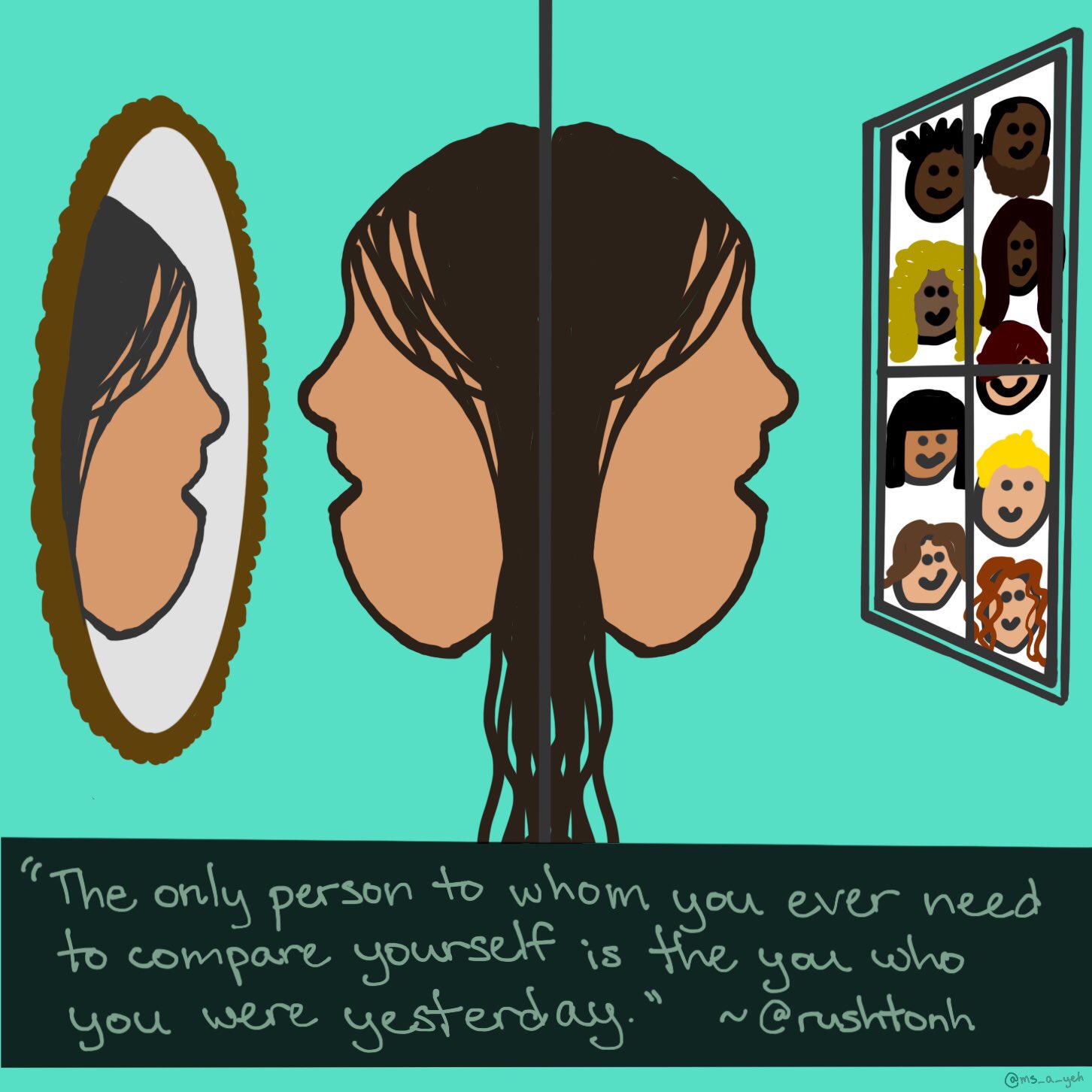
The day started off with a good reminder from keynote speaker Rushton Hurley

"The only person to whom you ever need to compare yourself is the you who you were yesterday."

Are you looking in the mirror to compare, or looking out the window at everyone else?


Image


After that, I had the opportunity to present on fun stuff: GSuite in the Arts, Spreadsheet AutoMagic, and some Google Experiment play at the playground. It reminded me (as always) that I really enjoy presenting! All of those little moments - the exclamations of "Oh, that's awesome!", "I am doing this with my kids on Monday!", and "That's so cool!" - filled my bucket. I always appreciate positive feedback (who doesn't?), but even more this year when I have felt like such a novice in my day-to-day job.

I think God knew I needed this reminder - despite all of the new, I still have strengths to bring to the table. I have a renewed sense of efficacy in being able to serve and help teachers & students. I have so much to learn, but I also have some good background to draw on.

Passing It On

Which, of course brings me to students. How often do we focus on their weaknesses, instead of their strengths? Do we recognize the background that they bring to the table as a source of learning? Do we make them feel like they are a beginner at everything, or do we value and build on their prior knowledge? These questions are especially relevant for our students who come with different cultural backgrounds that we do.

A little reminder goes a long way. Which student needs a little reminder from you today?

Friday, October 25, 2019

The Importance of Our Strengths

For anyone who knows me or has been following my blog, it's probably not a secret that it has been a tough beginning of the year for me. A district reorganization, a new job, new teams, and a lot of change means that I've been spending a lot of energy the past few months adjusting to the changes. And it's been hard.

As I continue to struggle with settling into my new job, I've tried to figure out why - and I had a realization today. I'm spending far more time working out of my weaknesses than out of my strengths.

What does this look like, practically? I'm supporting subject areas I'm just learning, while the teachers I am supporting have been teaching this class for years. I'm spending most of my day in meetings, rather than being out with teachers and students. And, in the areas where I feel like I have strengths, the work has shifted to other people/job functions, so I am not supposed to be doing these things (so we can all settle into our new roles).

It's frustrating. I also know that we are still in the beginning stages of this change, and sometimes things just take time.

Meanwhile, this has sparked many thoughts for me about how we treat our students. Are there kids in your class who feel like they spend their whole day working out of their weaknesses, and desperately want you to recognize their strengths (whether they are in traditional academics or elsewhere)? Do they feel like they are cut off from using their sources of strength to aid in their learning? What does this do to their confidence and their view of themselves as learners?

I hope that we can all take a strengths-based approach to see the beautiful strengths all of our students bring. They may be learning English, and they have a rich cultural and linguistic heritage from somewhere else. Their family may be staying with another family right now due to financial constraints, and they might have learned how to get along with a wide variety of people. They may have a disability, and they might have learned to think creatively about how to accomplish things. Which side are we going to focus on?

I hope that we, as educators, can leverages students' strengths to build their confidence and capacity as learners, allowing them to move onto bigger and bigger challenges and ultimately to soar!

(And I hope that, one of these days, I will find ways to bring my strengths more and more into my daily work!)

Saturday, October 12, 2019

Once a Teacher, Always a Teacher

I'm now entering my third year being out of the classroom. Three years. In some ways, it feels like forever ago, but in other ways, it feels like just yesterday that I had students of my own.

It's hard, sometimes, working at the district level. I miss kids. I miss those relationships that only develop when you see them every day. And I miss teaching itself - the art of crafting a lesson, knowing your learners, and connecting with kids in that moment!

I also worry about becoming irrelevant. About losing touch with what life is like when you are teaching kiddos day in and day out. I fear that I might forget the planning, the grading, the parent emails, the hallway duty, and the never-ending stream of wondering how you could help your kids even more.

But then I remember: Once a teacher, always a teacher. A couple of weeks ago, I got to teach a Sunday School lesson at church (to kindergarten/1st graders), and it was awesome. One of those moments where you feel like you have their attention, they are engaged and excited to learn, and everything is just clicking! And then, this week, due to ice and snow and bad roads, I got to be an emergency sub for a couple of hours (until all of the teachers could make it to school). It was so much fun to be teaching kids again! It made me remember that:
1) I still love this,
2) I can still do it (even if I am a little rusty), and
3) I never want to lose touch with teaching.

I'm a firm believer that, no matter where you are in education, it is important to be in schools and important to be in classrooms. That's where the rubber hits the road! I've tried to keep that lens and spend time in classrooms throughout my time in a district position, and I hope I can continue to find little ways to exercise my teaching heart as well!